
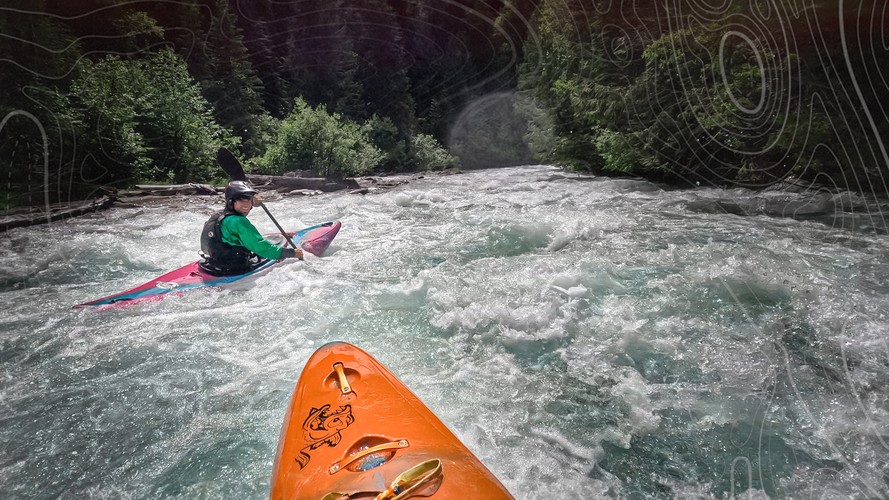
Opening Up Small River: Navigating Hidden Rapids in Robson Valley
Posted by Brooke on 2024 Sep 14th
Read our ambassador Brooke's article:
In her recent exploration of the Robson Valley, Brooke takes on the Small River—a lesser-known waterway tucked away near Mt. Robson. For kayakers and outdoor enthusiasts, her article provides practical guidance on navigating this narrow, low-volume creek. Brooke shares her firsthand experience of clearing the river of obstacles, such as wood and debris, making it safe for paddling.
This piece is particularly useful for those looking to explore new waters in British Columbia. Brooke offers clear, actionable advice on river access, safety, and the technical skills needed to tackle the Small River’s rapids. Whether you're planning a trip to the Robson Valley or simply curious about the challenges of paddling a rarely explored creek, her article addresses common concerns, such as identifying safe entry and exit points and managing the risks posed by natural obstacles.
Returning to the Robson Valley
I spent my summer this year back in the Robson Valley. About an hour west of Jasper on the BC side of the border, and nestled in the shadows of Mt. Robson there are many beautiful rivers and creeks. I raft guided here for Stellar Descents in 2023 and was stoked to return this year. I was particularly excited to see some familiar rivers and sections, as well as explore some new water that I didn't get to last year! One of those new rivers was the Small River!

The Stellar Descents team didn’t run Small River last year, and we were quite certain that no one else had either. After two springs/summers of no kayakers, we were pretty sure we'd have to clean up some wood before we'd get to kayak it. Early in the season my good kayaking homie (and raft boss at Stellar), Justin and I took a drive up the Small River FSR to see what the river looked like this year. We were right, and this drive ended up being just one of many before we got to kayak on it.
Preparing the River for Kayaking
We found three sections of hazardous wood that needed to come out before we were able to kayak it. We stopped to get out of the car and make a bit of a plan for each of the pieces. We wrote some details down to keep track of our thoughts. We also continued further upstream than what normally gets paddled to explore a bit more of the river. Just upstream is a 1km section of gnarly class 5 with a whole bunch of wood in it. If anyone is interested in running this section they better be ready to spend weeks taking wood out. This class 5 section is a very cool section of water to look at though! Above this is about 10 km of class 1-2+. Unfortunately it is also full of wood, so paddling it would include at least a few portages across bad, river wide logs, as well as lots of maneuvering around the rest. Further up the road is a very cool trapper cabin that hosts dog sled races in the winter time! We started back down the road only because we started to realize how little gas we had left. Good thing when you drive up river roads it's always downhill on the way back!
Day One: Tackling the First Section
We split up the wood removal over three different days. I was glad to have a part of what became a very cool experience! It was really cool to be able to use so many of the skills I've picked up in SRT courses along my whitewater journey. I’d never taken wood out of a river before, though it feels like we kayakers talk about the process of it so frequently.

The first section we decided to tackle was up near the top. The first rapid is an optional class 5 and it sits right underneath the put-in bridge. If a paddler were to choose to put-in below it, they would find that put-in overgrown and hard to access. First, we cleared out the trail and made it easier to access. Right below this put-in we got to work on the first section of wood. We went on a day we knew the water would be low. We brought our full suits and all the protective gear we wear kayaking, as well as a full size pin kit, some branch snippers, a handsaw, a sawzall, and a chainsaw. The water was shallow enough for us to wade in so all of our efforts were pretty simple. We started by removing the wood and branches that were small enough to pick up by hand. We dislodged them from rocks and tossed them downstream. Next we tackled some bigger pieces. We used the chainsaw to make stress cuts along the logs and let the force of the river break it apart. One of the challenges we encountered was keeping the blade of the chainsaw high enough out of the water. We tackled this by propping one end of the log up on rocks and the two of us rocked it back and forth until it was high enough. We took out three big logs and the next time we returned, all the small chunks were carried away by higher water. Day one complete!
Day Two: Complex Wood Removal
Day two was a lot more complex. There were three small birch trees hanging down in the water on the far bank. That bank was a steep cliff and it would be impossible to operate a chainsaw while standing on it. We decided that we would build a system where someone could ride in a ducky/IK to operate the chainsaw, and have one person on either side of the river controlling ropes to maneuver the ducky. It was quite a complex system, but it was one that Justin and I had both built and used before in prior SRT courses. I swam across below the trees and scampered along the cliff to set up the “weak side” anchor. A little ways upstream of the wood, I used some trees to anchor the rope. While I was setting up the weak side, Justin and Kinga were pumping and rigging the ducky, as well as setting up the “strong side.” When we were both ready, I threw them a throw bag to tie to the ducky. Before Justin hopped in to cut the wood, we started with a practice run to get the hang of maneuvering the ducky on the ropes. Were glad we did because I realized that I had set up the anchor a bit too far downstream. I added a redirect 1:1 system around a big rock to fix the angle. I also added a prusik to capture progress, to help manage the extra weight once Justin hopped in. When we got everything re adjusted we tried another practice round. It worked great this time! Justin hopped in with the chainsaw and all went smoothly. He was able to cut the branches high enough up the cliff that we deemed them “out of play.” Before we broke down the whole system I got to ride the ducky back across! We packed up all our gear and day two was complete.
Day Three: Ready to Paddle
We saved this last log for day three because it seemed like the least fun to get rid of. It was sitting in a deep fast channel, attached by its roots on the far bank, and tangled up in many other trees on the close bank. As it was river wide, and with no good access it was a little bit discouraging to look at. We waited until we had our good friend and co-worker from last year, Vibhor, come up for a visit to tackle it. We also promised him that once we had that log out he could join us for (this season's) first descent! We rolled up to the river with our kayaks for the first time, as well as with all our previous SRT/wood removal supplies. We got to the place where this last log was, and we were all very very happily surprised to find that high water had come and taken it away for us! Time to go kayaking!

We did two quick fun laps that day, and made plans to return soon. The Robson Valley is full of hidden gems like this one, along with classics like the upper Fraser, the Beaver, the Dore, and the Canoe. If you have a week to spare in June or July, it's absolutely worth the drive up to Tete Jaune Cache/Valemount to spend some time exploring the Robson Valley!
Small River Overview
If ever there was one word to describe the Small river, “Small” encapsulates it perfectly. Not only is it a narrow creek, it is also only three kilometers long, and it has a pretty small runnable window. Nevertheless, it is a worthwhile section to explore! The smaller volume nature of the river makes it a unique change from neighboring rivers. It feels a lot more like a creek/boulder garden style of paddling. A small shuttle makes it a fun section to run multiple times. It is also just a ‘small’ distance from the hamlet of Tete Jaune making it easy to access if you happen to be camping in the area.
The put-in and take-out are accessed at the Small River rest area along Highway 16 between Tete Jaune and McBride. Leave a car at the rest area next to the picnic tables for the takeout. There is a small beach along the river right side and a trail up to the picnic tables, and remember to take out before you paddle under the highway bridge! Head up the Forest Service Road (FSR) to the put-in. This is an active FSR, and is also used by horseback riders, ATVs, and dirtbikes. Be sure to watch your speed and exercise caution around blind corners.
There are multiple put-in options along the river. The top option is right underneath the first bridge you come across (right at the 3 km marker). Underneath the bridge is the only named rapid of the run, called Mr. Big. It is class 5 but totally optional. Take a look from the bridge to find your line, or to see just downstream where the next put-in option is. Along the river right side, before the river turns to the left is a small access point. Put-in here for about 250 m of class 4 that ends in a river wide hole, or put-in just below this hole for the bottom put-in option.
From roughly the 2.5 km mark on the road to the take-out is an exciting stretch of fast, continuous, class 3(+). There are minimal places to stop to clean up a swim and eddies are small, so a strong roll and confidence in class 3 is required. The river is mostly made up of gravel beds and small boulder gardens. Be sure to keep your eyes peeled for wood the whole way, as this is a section that does not frequently get paddled. There are plenty of fun rocks to splat, slide, and boof off of.
There is no gauge on the Small River but there are a few other rivers in the area that could be used to approximate the flow (Dore, Canoe). Just as the river is small, so is the watershed that feeds it. Late June through July is usually a safe bet. As you drive up the road take a look at the river. Low water is recommended for Mr. Big, however the rest of the run would be quite bumpy. If it looks good to go, it probably is!
For live updates on flows, river beta, camping recommendations, and general paddle homies in the Robson Valley area, phone Justin at Stellar Descents (250) 566-0040, or check out the Robson Valley Whitewater Facebook page.

Join Me on Instagram
For more adventures and behind-the-scenes moments, follow me on Instagram at @brooke_zel.3. Let's continue the journey together!